
Before we get into it, I want to point out something. People who actually live in Sevilla don’t call this derby “El Gran Derbi.” That name is a fairly recent PR move by La Liga, meant to make the derby sound a bit shinier for a wider audience. That said, the name has slowly started to stick, so we’ll use it here too.
Now let’s focus on the red and green of Andalusia’s capital and really try to understand this historic derby.
The History of the Derby: Where Does the Sevilla vs Real Betis Rivalry Come From?
Before we get into the origins of the derby, it’s worth talking a little about the people of Sevilla first. I think this short intro will help explain why this derby burns as hot as it does.
Sevilla, the City of Passion and Division
Sevilla loves splitting itself in two. Even before football arrived on Spanish soil, this city had already managed to divide itself over two famous matadors (toreros), Joselito and Juan Belmonte, and started its own eternal rivalry through them.
The city’s two most famous images of the Virgin Mary split it in two as well: Esperanza de Triana and Esperanza Macarena. Half the city is on the side of Macarena, the other half stands with Triana. People support these figures the same way they support a football team.
Sevillanos also split into those who love Feria de Sevilla, the city’s famous festival, and those who love Semana Santa, Holy Week, when the city has its most spectacular days. Some head to Feria, partly out of habit, partly because of neighborhood and friend circles, while others feel that same pull toward Semana Santa instead. But wherever they end up going, there’s one thing that unites them both: a suit for the men, and a dress for the women.
Once you see these kinds of deep divisions, it’s easy to understand just how passionate the people of this city are, and how fully they live out that passion. This kind of Mediterranean intensity naturally shows up in football too, built around the city’s two biggest clubs.
The Founding Stories of Sevilla FC and Real Betis
Sevilla’s Founding Story
Football arrived in the Andalusia region very early. In 1873, employees of a British company that had come to work the region’s copper mines founded Club Ingles Bella Vista in 1878. This is considered the first, unofficial football club known in Spain. Spain’s first official football club is Recreativo de Huelva, founded in 1889 in the city of Huelva, about 90km from Sevilla. About a year after Recreativo de Huelva was founded, in 1890, Sevilla FC was founded. In fact, these two clubs played what’s considered Spanish football’s first official match against each other. Sevilla won that match 2-0.
Some sources list Sevilla FC’s founding as 1905, but the club itself lists 1890 as its founding year. Since Scots and Englishmen were involved in founding the club, it took the name “Sevilla FC.” That “FC” would later become one of the first, and biggest, things separating Sevilla from Betis.
Real Betis’s Founding Story
Real Betis’s founding story is really what takes us straight to the root of the rivalry. As the story goes, a group of young men first split off from Sevilla Football Club and founded a club called “Sevilla Balompié.” Balompié is the direct Spanish translation of “football.” These young men didn’t want to be associated with the “FC” in the name, so they founded Sevilla Balompié, and their rivalry with Sevilla FC began. Sevilla Balompié’s colors were blue and white, known to have come from Glasgow.
According to another version of the story, Sevilla FC played a match against Sevilla Balompié in 1909 and lost. After that defeat, Sevilla FC’s leadership made a decision as a club: from then on, players from the lower classes would no longer be allowed to play for Sevilla FC, and the club’s red would only be worn by those who “deserved” it. In a sense, the blame for the loss was pinned on the working-class players in the squad. A group from the club’s board, led by Eladio García de la Borbolla, objected to this decision, split from Sevilla FC, and founded a club called Betis FC. They took the name “Betis” from the Roman-era name of the Guadalquivir, the river that runs through the middle of the city and has become inseparable from Sevilla’s identity.
By this point, the city of Sevilla had three clubs: Sevilla FC, Sevilla Balompié, and Betis FC. When 1914 came around, Sevilla Balompié and Betis FC decided to merge, forming Betis Balompié and officially taking their place in history under the green and white colors. Right after its founding, the club received the “Real” title from King Alfonso XIII, becoming Real Betis Balompié, the name that carries through to today.
According to sources, the first-ever match between Sevilla and Real Betis ended in a 4-3 win for Sevilla. But the first official match between Sevilla FC and Real Betis was played in La Liga’s 1928-1929 season, and it ended in a 3-0 win for Real Betis. The second match that same season was also won by Real Betis, 2-1.
The Differences Between Sevilla FC and Real Betis
The Early Roots of the Sevilla FC vs Real Betis Rivalry
Like a lot of derbies around the world, the Sevilla vs Betis derby is more than just a match. What started as a class divide has drifted in different directions over the years.
If you look at derbies around the world, a lot of them come down to a big club versus a small club. That was never really the case here, at least not until Sevilla started dominating European football, especially the UEFA Cup, from the early 2000s onward. Even so, the rivalry between these two clubs shows up more in identity, self-image, and civic pride than in football status.
Since the day it was founded, Sevilla FC has been tied to Nervión, the district where its stadium sits. Since Nervión was more of an upper-class neighborhood back then, and since the people on Sevilla’s first board came from the city’s upper crust, Sevilla FC has always been associated with the bourgeoisie.
Triana, the neighborhood that played a key role in Betis’s founding, represented more of the working class and the overlooked, so Real Betis became identified with the working class too. That’s why Betis has always been seen more as the people’s team. Heliópolis, where Real Betis’s stadium sits, was also historically home to the lower and working classes.
These days though, both Nervión and Heliópolis have turned into pretty upscale neighborhoods. Heliópolis, in fact, is currently home to an even more elite crowd than Nervión.
So even though you can see this kind of class divide at the roots of the rivalry, we really can’t talk about that same divide today. Both teams are supported by fans from every class and every background.
Sevilla FC and Real Betis in the Postmodern Era
These days, Sevilla FC (setting aside the last couple of years) tends to come across as more organized, success-driven, serious, and ambitious, and their fans take pride in that identity. It’s a team where success gets rewarded and failure gets criticized. Their run of UEFA Cup wins, their success in European competitions, and their steady presence in La Liga all fit that same philosophy. Sevilla fans always want to win, they want to see a winning team, and they measure themselves by that.
Real Betis fans, on the other hand, lean more toward a “win or lose, doesn’t matter” mindset, prioritizing belonging to the club over success itself, and their fans take pride in that too. The slogan “Viva el Betis manque pierda” (“Long live Betis, even if they lose”) says it all. Sevilla fans like to poke fun at that “manque pierda” mentality, saying “that’s exactly why they never win anything.” But for Betis fans, that doesn’t matter. What matters is standing by the team.
These two mindsets actually show us what each set of fans takes pride in. My own take is that both clubs are expressing the same underlying emotion, just in different ways.
Betis fans express Andalusia’s emotional intensity through devotion to the team, through always being there for the club no matter what, through never giving up on that love even in defeat. Sevilla fans express that same Andalusian emotional intensity through endless love and endless respect for the club, a kind of respect with real emotional weight behind it, which is exactly why things like losing or sitting low in the table feel unacceptable to them.
At the end of the day, both sets of fans are expressing their own emotional intensity, just through different channels.
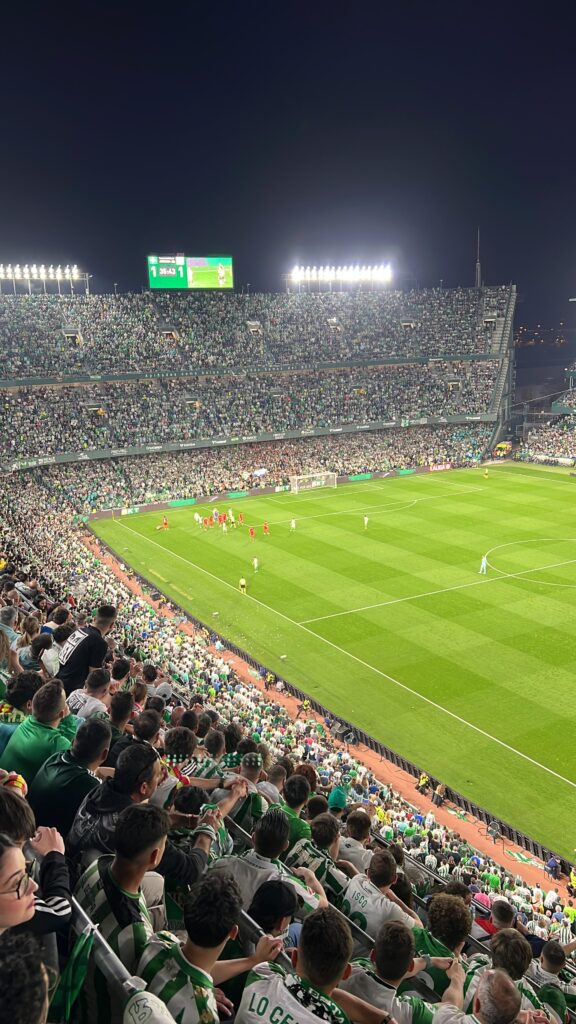
The Political Side of the Sevilla FC vs Real Betis Rivalry
If you look at how this rivalry is usually framed today, you’d probably expect Real Betis to lean left and Sevilla FC to lean right. That’s what football culture generally teaches us to expect. But here’s where things get a bit more complicated than that.
Real Betis’s ultras group, Gol Sur, is known as right-leaning and conservative. There have even been reports of fascist chanting at some matches. The most recent example is the Nazi salute and the singing of “Cara al Sol” by traveling fans at the away match against Celta Vigo in 2025. Even though this was carried out by a small, marginal group, Betis’s ultras are known among Spanish ultra groups as being right-leaning, and they’re often accused of fascist sympathies by left-leaning ultra groups.
Sevilla FC’s fan group, Biris Norte, on the other hand, is generally left-leaning, antifascist, and revolutionary. They’re closely aligned with Spain’s other left-leaning terraces and aren’t shy about showing it. They’re also known to have a close relationship with Bukaneros, one of the country’s most left-leaning fan groups.
Of course, these are just general profiles of each club’s ultra groups. Within those ultra groups themselves you’ll find people of different political leanings, and among each club’s wider fanbase you’ll find plenty of people on both the left and the right.
Among both clubs’ fans you’ll find people from the left, the right, the upper class, the working class, immigrants, and even people from royal lineage. This shows both how diverse the city of Sevilla is, and how this derby’s roots have, in some ways, drifted somewhere else entirely from where they started. Generalizing either fanbase just doesn’t really hold up in today’s world.
The Dark Moments of the Sevilla FC vs Real Betis Derby
Now let’s get into this derby’s most dramatic stories. Like every derby, the Sevilla FC vs Real Betis derby has had its share of strange, unsettling, and sometimes genuinely dark moments. Because we all know football is never just football, and it never stays confined to what happens on the pitch. Let’s look at some of this derby’s darker moments together.
The 2007 Botellazo Incident and “The Bust Derby”
In 2007, a derby was set to be played at Real Betis’s stadium. Sevilla’s well-known president, José María del Nido, went to watch the match at Betis’s stadium despite being told he wasn’t allowed in. Naturally, he wasn’t welcomed warmly, but he took his seat in the VIP section anyway. What he didn’t expect was a surprise waiting for him: right behind his seat sat a bust of Manuel Ruiz de Lopera, Betis’s president at the time, whose name the stadium carried. The bust was placed so cleverly that every time the broadcast cut to the VIP box, there was Sevilla’s president, with Betis’s president’s statue looming right behind him.
Naturally, del Nido didn’t take it lying down. There was pushing and shouting in the VIP section. Del Nido got into an actual scuffle with Lopera’s nephew. There are even reports of homophobic insults being thrown around. It’s worth mentioning here that both presidents were pretty successful men, but just as egotistical. Del Nido was bold enough to say, after a string of European trophies, that he was “the most important man in Sevilla after the Pope.” Lopera, meanwhile, was bold enough to put his own name on Real Betis’s stadium. Both presidents were genuinely successful during their time in charge, but they never stopped clashing with each other either. It’s known that Lopera refused to even say del Nido’s name, calling him by his second surname instead.
This bust incident, which left its mark on Spanish football, was actually just the first link in a chain of events that would unfold over that February 2007.
Sevilla won that match. Del Nido, leaving the stadium, celebrated the win loudly and openly. Two weeks after that match, another Sevilla derby took place, this time a Copa del Rey match at Real Betis’s stadium (known back then as Estadio Lopera). In the first half, while Sevilla were celebrating a Kanouté goal, a bottle was thrown from the stands toward the Sevilla bench. It hit Sevilla’s manager, Juande Ramos. The bottle was plastic, but filled with water, and the water was frozen solid. Struck in the back of the neck by the frozen bottle, Ramos passed out and was taken to the hospital. The match was suspended.
Sevilla fans called it an act of barbarism. Betis fans claimed Ramos had exaggerated the whole thing, that it wasn’t really as big a deal as it was made out to be.
That year turned out to matter for another reason too: not long after, Sevilla player Antonio Puerta passed away. Betis fans attended Puerta’s funeral. That funeral brought the city’s two clubs together, maybe for the first time, even if only briefly.
A Few Notable Incidents from the Sevilla FC vs Real Betis Derby
Here’s a list of a few things that have happened over the course of this derby. There are certainly more we haven’t included, but here’s what we could gather for now.
- In a 1918 derby between these two clubs, Sevilla player Manuel Pérez was stabbed by a Betis fan.
- In 2000, during a derby, Betis goalkeeper Toni Prats was attacked by a fan who ran onto the pitch. Since the attacker used a lighter, this incident is also known as “the lighter incident.”
- Before the 2022 derby, Betis fans killed a rabbit, dressed it in a Sevilla shirt, and hung it from a bridge.
- In the 2022 derby, Sevilla player Joan Jordán was struck in the head by a thrown PVC pole.
- On days this derby is played, tall bar stools are banned from being left outside bars around the stadium.
Important Numbers and Quick Fact Box
These two clubs have faced each other 145 times in total. Sevilla have won 66 of those matches, Betis 42. 37 matches ended in a draw.
Jesús Navas holds the record for most appearances in the Sevilla vs Betis derby for Sevilla. On the Betis side, that record belongs to the club’s legend, Joaquín.
The highest-scoring match between the two clubs was played on January 6, 2018. Played at Ramón Sánchez-Pizjuán, Real Betis won 5-3.
Real Betis beat Sevilla 4-2 at the opening match of Sevilla’s current stadium in 1958. Betis fans still bring this up to needle Sevilla fans to this day.
For Anyone Wanting to Visit for the Sevilla FC vs Real Betis Derby
If you want to go to this derby, you definitely need to be careful. Tension runs high across the whole city. You’ll need to follow the instructions of the police, who’ll be visible everywhere. That part’s fairly obvious.
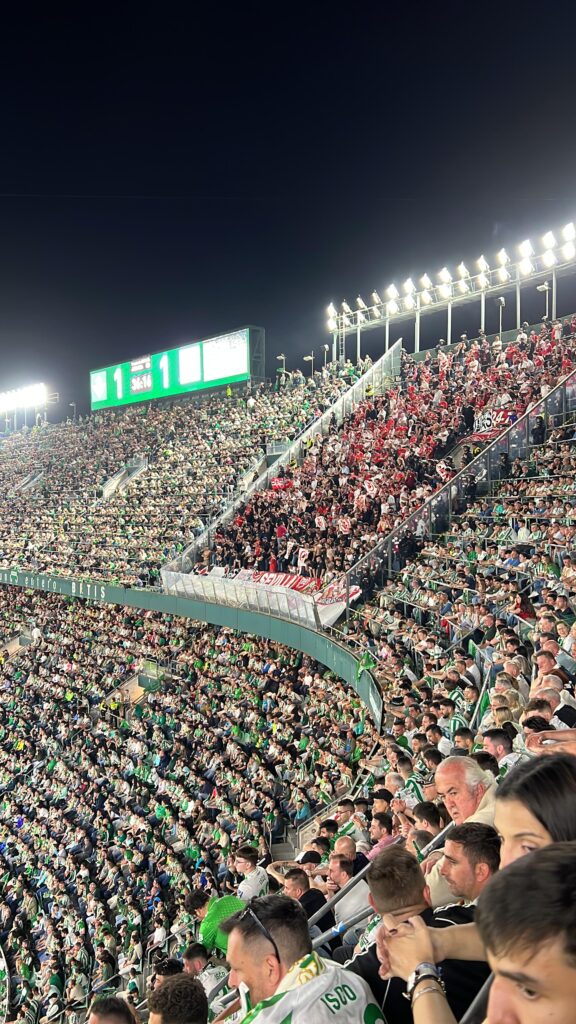
On derby day, the areas around both clubs’ stadiums are the biggest gathering spots for celebration. Don’t walk around wearing the other team’s shirt or gear there, and if you can help it, avoid even wearing the other team’s colors. If you happen to know someone who supports one of these two clubs, the best move is to stick with them and just let yourself get swept up in the match and the atmosphere.
Generally speaking, the people of Sevilla are calm, easygoing, and love to have a good time. So if someone gets the chance to experience this derby, the best advice I can give is: go with the flow, and enjoy it.