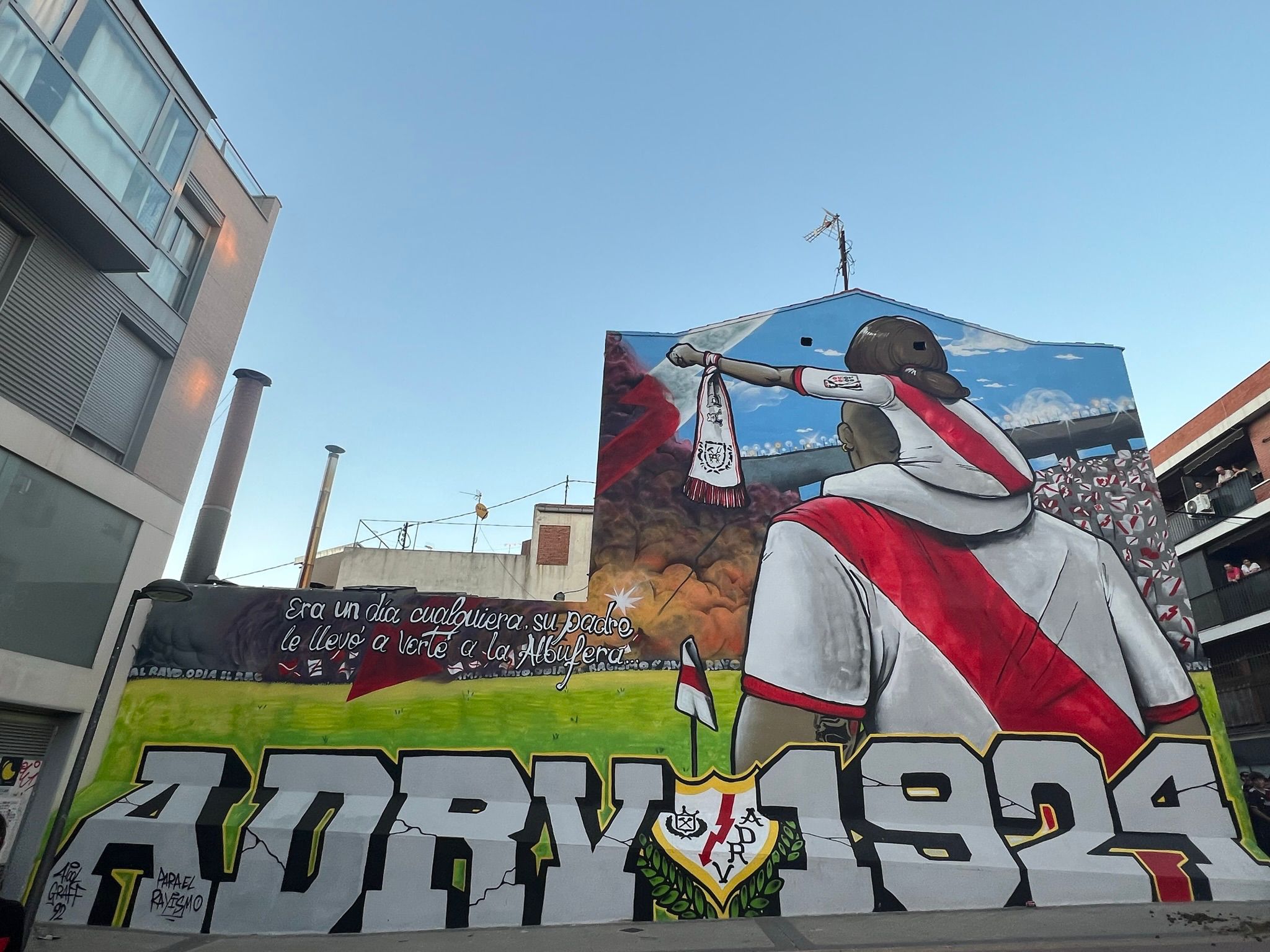
La Vida Pirata, La Vida Mejor: Rayo Vallecano and the Bukaneros
There was a time when people felt the need to prove that football was never just football. These days, the fight is almost the opposite — trying to keep football feeling like football, while the game gets polished into a product and sold back to us. Which is exactly why stories like this one are worth telling. So let’s take a short trip to a working-class corner of Madrid, and look at a story that still has something to say.
Football Comes to Madrid
When football arrived in Spain, Madrid had no resistance to it. The infection came by way of Spanish students who’d studied in England, caught the bug there, and brought it home with them. Within twenty years it had spread through every street of the capital, and then through the rest of the country. By the time Franco’s dictatorship tightened its grip, football in Spain had already become something bigger than entertainment — a reason for people to gather, and, quietly, a place to share ideas that couldn’t be shared openly anywhere else.
The City That Never Fell
You can’t talk about Spanish football without the country’s recent history sitting right underneath it. The scars of the Civil War run through Spain’s social and cultural fabric, and nowhere is that more visible than in Madrid.
During the Spanish Civil War, Madrid held out for two and a half years without falling. When the city was officially surrendered in 1939, there was no resistance left to give — the war was already lost, the Republic already defeated, and further bloodshed would have served no purpose. But up until that point, for two and a half years, Madrid fought.
Many hands held that resistance together, but one of the more storied contributors was the 15th International Brigade — volunteers from dozens of countries who came to defend a city that wasn’t their own, and who helped Madrid hold out as long as it did.
The Years Under Dictatorship
Under Franco’s dictatorship, Madrid — as the capital — was naturally the country’s center of gravity for work and opportunity. The industrialization of the 1950s, and the wave of urban migration that followed, will sound familiar to anyone who knows Turkey’s own mid-century story. The first great migration wave into Madrid began in this same period.
Those who came to Madrid didn’t exactly build shantytowns, but they weren’t let into the city center either. They settled around the edges, pushed out toward the M-30 ring road. The ones who arrived from the south of Spain settled in a neighborhood called Vallecas.
At first, people came to Vallecas from all over Spain — and even fellow Spaniards were treated as “outsiders” there. It became, in every real sense, an immigrant neighborhood, and for a long time it carried a reputation as a “dangerous” one. Later, people from outside Spain arrived too. But the idea of who counted as an “outsider” never really mattered in Vallecas, because the neighborhood had already built its own identity around something else entirely: socialism.
Vallecas’s socialist roots reach back to the 19th century, and the neighborhood served as a gathering place during the Civil War itself. But it was the migration wave of the 1950s, and the working class settling there, that fused with the area’s existing culture to form a genuine socialist stronghold. Vallecas’s first elected mayor, Amos Acero, was a committed socialist — a schoolteacher elected in 1931 who served the neighborhood for roughly eight years. In 1939, with a bounty placed on his head by Franco, he was forced to flee. The fascist regime caught him at the docks in Alicante, forced him through various labor camps, and executed him in 1941. His last words: “If things ever change, I want to be buried in Vallecas, among my people, among the people who shaped who I became.” Eventually, that wish was granted.
The Founding of Rayo Vallecano
Rayo Vallecano was founded in 1912 by socialist young people, shaped from the very beginning by the culture of this neighborhood. From the moment those seeds were planted, the club has never really strayed from Vallecas’s values — carrying them from the first migration wave of the early 1900s, through the fall of Franco, right up to today. For the people of this neighborhood, Rayo isn’t a football club. It’s closer to a religion — an organization where a community that takes pride in its working-class roots shares its joys and its grief, its solidarity and its anger, together.
Supporters of this club — still, in many ways, a neighborhood outsider within Madrid itself — come from all over Spain and the world, united around anti-fascism, socialism, workers’ rights, children’s rights, LGBTQ+ rights, and opposition to the industrialization of football.
Rayo Vallecano’s Club Culture
Being home to some of La Liga’s most politically active and aware supporters isn’t an easy position to hold. Competing in one of the biggest leagues in the world generally demands that a club, at minimum, becomes more corporate. Vallecas’s fans resist that pull anyway.
Match tickets, for instance, still can’t be bought online — an e-ticketing system is practically a dirty word here. If you want to go to a match, you go to the stadium, stand in line, and buy your ticket in person. There are several reasons for this. Not wanting to be tracked digitally is, first of all, everyone’s right. But Rayo’s fans are also thinking of the club employees who’d lose their jobs if ticketing moved fully online. And in general: the more you can resist industrialization and corporatization, the better. The stadium itself — unrenovated, standing in the same spot for over sixty years — is part of the same resistance.
A more recent example: the story of Roman Zozulya’s transfer to Rayo, blocked by the club’s own supporters — something worth its own full article one day. Zozulya, a Ukrainian player with known Nazi sympathies, was loaned to Rayo Vallecano in 2016 after two years at Real Betis. The terraces reacted so fiercely that the club’s management was forced to cancel the transfer.
La Vida Pirata: The Bukaneros
“When God was handing out brains, we got the smallest share. But when God was handing out balls, we got the biggest one.”
That’s what a Bukaneros supporter told me one September evening at a La Liga match — and honestly, the Bukaneros, Rayo Vallecano’s most influential supporters’ group, earn that line. Fiercely loyal to the culture of the neighborhood, they’re one of La Liga’s most committed antifascist supporter groups. The political banners they unfurl during matches, the anti-Nazi flags, the LGBTQ+ flags, the Che Guevara imagery, the songs nobody else in the league sings — this is a group that has never gotten the recognition it deserves.
Whether they care about that recognition or not, the Bukaneros are something close to a badge of honor for La Liga’s fan culture. In a football world that’s increasingly rotten and creeping toward its own fascism, the Bukaneros hold space for workers, migrants, and outsiders — and defend both Madrid and their own neighborhood against it. Not so different, in spirit, from the international volunteers of the 15th Brigade who defended this same city decades before them.
Let’s leave the last word to the Bukaneros themselves:
“La Vida Pirata, La Vida Mejor. Sin trabajar, sin estudiar.”
The pirate life, the better life. No working, no studying.